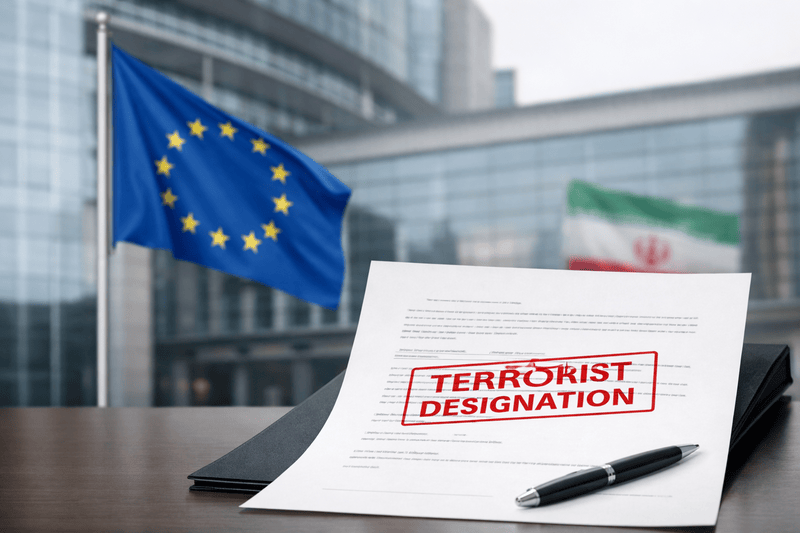
European Union Lists Iran’s Revolutionary Guard Corps as Terrorist Organization [1]
On February 19, 2026, the European Union (EU) listed [3] the Islamic Revolutionary Guard Corps (IRGC) as a terrorist organization, due to the killing of large numbers of civilians during nationwide protests. The IRGC was created [4] after the 1979 Islamic revolution and has remained a central power in Iran. It has maintained its influence using repression and force through military, political, and economic roles in Iran. The Basij unit, which is overseen by the IRGC, allegedly slaughtered thousands of civilians while they were advocating peacefully for basic human rights and economic relief.
The EU has also imposed sanctions [5] on 15 individuals and six entities responsible for serious human rights violations in Iran, including Interior Minister Eskandar Momeni, Judge Iman Afshari, Prosecutor General Mohammad Movahedi-Azad, and General Ali Abdollahi Aliabadi, head of Iran’s joint command headquarters.
The IRGC will be subjected to restrictive measures under the EU’s counterterrorism sanctions regime. This will include the freezing of funds, financial assets, and economic resources within EU member states.
Yet, the designation has raised legal and diplomatic concerns [6]. Iranian officials argued the terrorist listings must be based on judicial findings from a member state, under EU law—a requirement they say has not been met.
Abbas Araghchi accused [7] the EU of hypocrisy, warning that labeling Iran’s national military as a terrorist organization is a strategic mistake that will have economic consequences, including surging energy prices. However, Kaja Kallas, the European Union’s high representative for foreign affairs and security policy, declared [8], “Any regime that kills thousands of its own people is working toward its own demise.”
Picture generated by AI